Five of seven RC holes return 7–29 m intervals at 0.53%–0.77% TREO to EOH; two deep five-metre intervals exceed 0.90% TREO and 0.23% MREO
BELO HORIZONTE, Brazil and SINGAPORE — September 8, 2026 — Magnes Rare Earths (“Magnes”), a wholly owned subsidiary of Verde AgriTech Ltd. (TSX: NPK | OTCQX: VNPKF) (“Verde” or the “Company”), is pleased to report additional head-grade rare earth assay results from 146 drill holes totalling 1,299 assayed metres at the Minas Americas Global Alliance project (“Minas Americas” or the “Project”) in Minas Gerais, Brazil. The results comprise 139 completed auger holes totalling 1,027 m and the first seven completed or reconciled reverse-circulation (“RC”) holes comprising 272 assayed metres.
The new auger results are led by MAV_AD_0375, the highest-grade full-hole, from-surface interval reported at Minas Americas to date. The hole returned 15 m from surface to the end of hole (“EOH”) averaging 11,480 parts per million (“ppm”) total rare earth oxides (“TREO”), or 1.15% TREO, and 2,830 ppm magnetic rare earth oxides (“MREO”), comprising 2,752 ppm NdPr oxides and 79 ppm DyTb oxides. MREO represents 24.7% of TREO in the interval. Within the continuous 15 m profile, one metre from 12 m to 13 m returned 19,952 ppm TREO (2.00% TREO) and 5,909 ppm MREO.
The first RC results add a new vertical dimension to the drill-derived dataset. Five of the seven holes returned 7–29 m intervals averaging 0.53%–0.77% TREO to EOH, including four intervals at least 15 m long. MAV_RC_0012 returned 29 m from 31 m to the 60 m EOH at 5,751 ppm TREO (0.58% TREO) and 1,346 ppm MREO. Two separate five-metre intervals at depths between 38 m and 51 m exceeded 0.90% TREO and 0.23% MREO: MAV_RC_0012 returned 5 m from 38 m to 43 m at 9,106 ppm TREO, 2,315 ppm MREO and 566 ppm heavy rare-earth oxides (“HREO”), including 100 ppm DyTb oxides; MAV_RC_0005 returned 5 m from 46 m to 51 m at 9,191 ppm TREO, 2,429 ppm MREO and 430 ppm HREO, including 91 ppm DyTb oxides.
| “Today’s results give us the strongest combination yet of near-surface grade, depth and magnet rare-earth content at Minas Americas,” said Cristiano Veloso, Founder and Chief Executive Officer of Magnes Rare Earths. “Fifteen metres at 1.15% TREO from surface establishes a new full-hole benchmark for the Project. Just as importantly, our first RC drilling has identified multiple broad, higher-grade intervals far below the reach of the auger program. Five of seven RC holes carry intervals grading between 0.53% and 0.77% TREO to their current depth limits, including 29 metres at 0.58% TREO to the bottom of a 60-metre hole. The heavy rare-earth component is also emerging in both shallow and deeper drilling, led by 5 metres at 566 ppm HREO—including 100 ppm dysprosium-plus-terbium oxides—in MAV_RC_0012.” |
| “Rare-earth projects will ultimately be judged on recoverable magnet products, not head grade alone. The next value-defining work is to test beneath these current depth limits, connect the expanded dataset in three dimensions and determine recoveries from representative drill composites. With 443 holes and more than 3.6 kilometres of reported assays, Minas Americas now has a substantially stronger platform for that work and for the planned maiden mineral resource estimate.” |
Prior to this release, Magnes had reported assay results from 297 auger holes totalling 2,329.8 m at Minas Americas. This release adds 139 auger holes totalling 1,027 m and seven RC holes comprising 272 assayed metres, for 146 holes and 1,299 m. Cumulative reported assay drilling now totals 443 holes and 3,628.8 m.
Highlights
- Highest-grade full-hole result reported to date: MAV_AD_0375 returned 15 m from surface to EOH at 11,480
ppm TREO (1.15% TREO) and 2,830 ppm MREO, comprising 2,752 ppm NdPr and 79 ppm DyTb. MREO
represents 24.7% of TREO in the interval, which includes one metre at 19,952 ppm TREO (2.00% TREO) and
5,909 ppm MREO.
- Broad interval at depth: MAV_RC_0012 returned 29 m from 31 m to the 60 m EOH at 5,751 ppm TREO (0.58%
TREO) and 1,346 ppm MREO, including 14 m at 6,636 ppm TREO and 1,561 ppm MREO and 5 m at 9,106
ppm TREO and 2,315 ppm MREO. No composite crosses the documented 30–31 m no-recovery interval.
- Five of seven RC holes carry elevated grades to EOH: five holes returned 7–29 m intervals averaging 5,258–
7,744 ppm TREO (0.53%–0.77% TREO) to their current depth limits, including four intervals at least 15 m
long. Mineralization below the current EOH depths remains untested.
- Two deep intervals above 0.90% TREO and 0.23% MREO: MAV_RC_0005 returned 5 m from 46 m to 51 m at
9,191 ppm TREO (0.92% TREO) and 2,429 ppm MREO, while MAV_RC_0012 returned 5 m from 38 m to 43 m
at 9,106 ppm TREO (0.91% TREO) and 2,315 ppm MREO.
- Broad mineralization from surface: MAV_RC_0007 intersected 27 m from surface to EOH at 5,258 ppm TREO
(0.53% TREO) and 1,207 ppm MREO, including 10 m from 7 m to 17 m at 8,215 ppm TREO (0.82% TREO)
and 1,969 ppm MREO.
- High auger grades repeat across multiple holes: four separate auger holes returned complete, from-surface
averages of 0.86%–1.15% TREO over 8–15 m. Across the full auger package, 35 of 139 holes—one in four—
averaged at least 4,000 ppm TREO (0.40% TREO) over a combined 300 m.
- Heavy rare-earth oxides accompany high-grade TREO: MAV_RC_0012 returned 5 m at 566 ppm HREO,
including 100 ppm DyTb, while MAV_RC_0005 returned 5 m at 430 ppm HREO, including 91 ppm DyTb.
The 272 assayed RC metres average 145.5 ppm HREO, including 29.8 ppm DyTb.
- Elevated grades at current depth limits: six of the seven RC holes returned more than 4,000 ppm TREO in
their final assayed metre, identifying clear targets for deeper follow-up drilling.
- Cumulative scale: reported assay drilling at Minas Americas now stands at 443 holes and 3,628.8 m
The 4,000 ppm and 7,000 ppm thresholds are used only to summarize assay results and are not mineral-resource cut-off grades or economic thresholds.
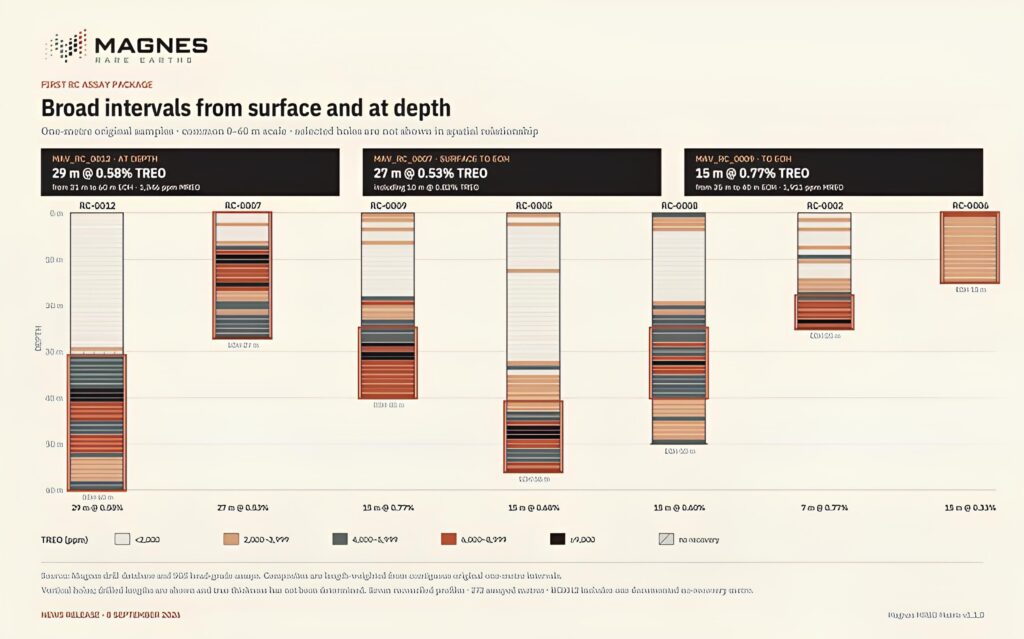
Figure 1. TREO head grade by drilled depth for the seven RC holes reported in this release. Each column uses a common 0–60 m vertical scale.
Highlighted outlines identify selected length-weighted composites of contiguous, original one-metre samples. The hatched interval in MAV_RC_0012 denotes a documented no-recovery interval. Holes are arranged for comparison and are not shown in spatial relationship.
Why These Results Matter
The first RC assays materially extend the drill-derived dataset below auger depths. In MAV_RC_0012, the 29 m lower interval below the documented no-recovery gap averages 5,751 ppm TREO and 1,346 ppm MREO to 60 m—more than eight times the TREO grade and ten times the MREO grade of the upper 30 assayed metres.
Five of seven RC holes returned elevated intervals to EOH and six ended above 4,000 ppm TREO in their final assayed metre, creating specific deeper-drilling targets. Comparable grades below current EOH depths and continuity between holes remain untested.
Why the Magnet-Rare-Earth Basket Matters
Neodymium, praseodymium, dysprosium and terbium—the four oxides in MREO—are used in high-performance permanent magnets. The International Energy Agency’s 2026 Rare Earth Elements report estimates that permanent magnets account for approximately 95% of global rare-earth consumption by value and that demand for these four elements is set to grow by a further one-third by 2030 under current policy settings.
Minas Americas assays quantify all four magnet oxides. Across 272 assayed RC metres, MREO averages 828 ppm, or 22.8% of TREO, led by 798 ppm NdPr with 29.8 ppm DyTb. MAV_AD_0375 averages 2,830 ppm MREO (0.28%); the two deep five-metre RC intervals average 2,315 ppm and 2,429 ppm MREO.
Earlier leach tests indicated ionic adsorption behaviour. These results are head grades and do not establish desorbability or recovery. Representative drill-based metallurgical testwork is the next major test of how the magnet-oxide grades may translate into a recoverable product.
Heavy Rare-Earth Oxides: The Dysprosium–Terbium Magnet Subset
Beyond the strong TREO and MREO results, the assays quantify a distinct heavy rare-earth component. MAV_RC_0012 returned 5 m from 38 m to 43 m averaging 566 ppm HREO, including 100 ppm combined Dy2O3 and Tb4O7, within the interval grading 9,106 ppm TREO and 2,315 ppm MREO. MAV_RC_0005 returned 5 m from 46 m to 51 m at 430 ppm HREO, including 91 ppm DyTb; MAV_RC_0002 returned 7 m from 18 m to EOH at 357 ppm HREO, including 69 ppm DyTb; and MAV_AD_0375 returned 15 m from surface to EOH at 322 ppm HREO, including 79 ppm DyTb.
| Selected September intervals · length-weighted head grades · ppm oxide equivalent |
| HEAVY RARE-EARTH OXIDES · 8 SEPTEMBER 2026 |
Heavy rare-earth oxides were present in the final assayed metre of every RC hole, ranging from 118 ppm to 345 ppm HREO and from 26 ppm to 75 ppm DyTb. These end-of-hole assays strengthen the rationale for deeper follow-up, but do not establish grade continuity below the current hole limits. Across all 272 assayed RC metres, HREO averages 145.5 ppm, including 29.8 ppm DyTb.
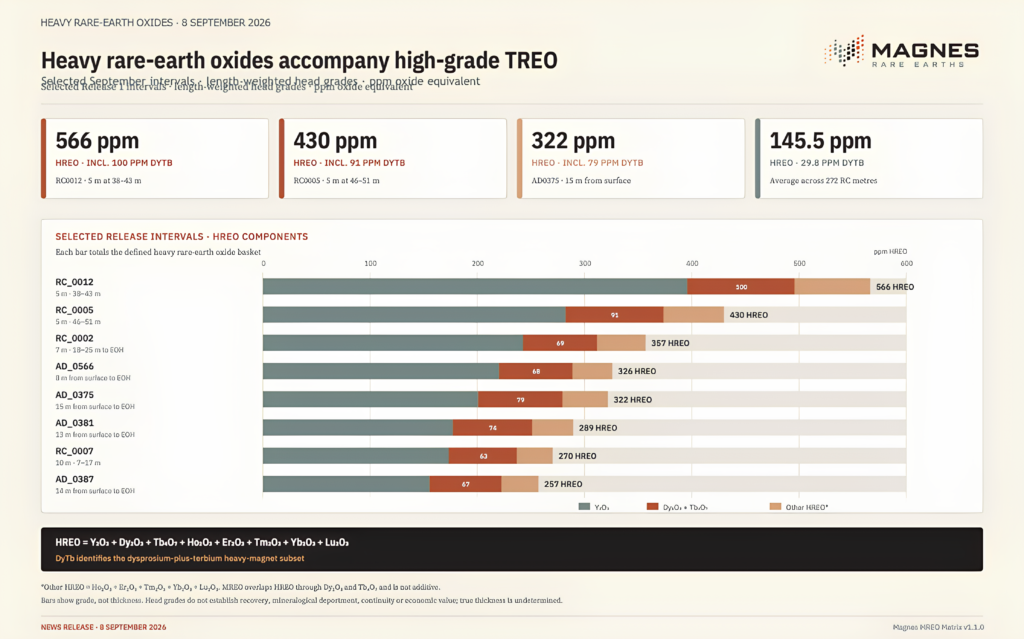
Figure 2. Heavy rare-earth oxide head grades in selected auger and RC intervals reported in this release. Stacked bars partition HREO into Y2O3, combined Dy2O3 and Tb4O7, and the remaining defined heavy rare-earth oxides. Bar length represents grade, not interval thickness. These are head-grade assays and do not establish recovery, mineralogical deportment, continuity or economic value.
For this release, HREO is defined as the sum of Y2O3, Dy2O3, Tb4O7, Ho2O3, Er2O3, Tm2O3, Yb2O3 and Lu2O3. DyTb is the combined Dy2O3 and Tb4O7 heavy-magnet subset. MREO overlaps HREO through Dy2O3 and Tb4O7 and the two metrics are not additive. Representative metallurgical testing is required to determine recoverability.
| Hole |
From (m) |
To (m) |
Interval (m) |
TREO (ppm) |
TREO (%) |
MREO (ppm) |
MREO/TREO |
NdPr (ppm) |
DyTb (ppm) |
| MAV_AD_0375 |
0 |
15 EOH |
15 |
11,480 |
1.15% |
2,830 |
24.7% |
2,752 |
79 |
| MAV_AD_0381 |
0 |
13 EOH |
13 |
9,380 |
0.94% |
2,555 |
27.2% |
2,481 |
74 |
| MAV_AD_0387 |
0 |
14 EOH |
14 |
8,930 |
0.89% |
2,275 |
25.5% |
2,208 |
67 |
| MAV_AD_0566 |
0 |
8 EOH |
8 |
8,565 |
0.86% |
1,999 |
23.3% |
1,930 |
68 |
| MAV_AD_0418 |
0 |
6 EOH |
6 |
6,627 |
0.66% |
1,601 |
24.2% |
1,547 |
55 |
| MAV_AD_0447 |
0 |
14 EOH |
14 |
6,195 |
0.62% |
1,390 |
22.4% |
1,343 |
47 |
Table 1 presents selected full-hole, from-surface auger composites. Complete hole-level results and drill-collar information for the holes reported in this release will be set out in the accompanying Minas Americas Drill-Hole and Assay Results Annex — 8 Sep 2026.
| Hole |
From (m) |
To (m) |
Interval (m) |
TREO (ppm) |
TREO (%) |
MREO (ppm) |
MREO/TREO |
NdPr (ppm) |
DyTb (ppm) |
| MAV_RC_0012* |
0 |
30 |
30 |
705 |
0.07% |
131 |
18.6% |
125 |
6 |
| MAV_RC_0012* |
31 |
60 EOH |
29 |
5,751 |
0.58% |
1,346 |
23.4% |
1,294 |
52 |
| including |
31 |
45 |
14 |
6,636 |
0.66% |
1,561 |
23.5% |
1,495 |
66 |
| including |
38 |
43 |
5 |
9,106 |
0.91% |
2,315 |
25.4% |
2,215 |
100 |
| MAV_RC_0007 |
0 |
27 EOH |
27 |
5,258 |
0.53% |
1,207 |
23.0% |
1,164 |
43 |
| including |
7 |
17 |
10 |
8,215 |
0.82% |
1,969 |
24.0% |
1,906 |
63 |
| MAV_RC_0009 |
0 |
40 EOH |
40 |
4,295 |
0.43% |
1,004 |
23.4% |
970 |
33 |
| including |
25 |
40 EOH |
15 |
7,744 |
0.77% |
1,911 |
24.7% |
1,851 |
60 |
| MAV_RC_0005 |
0 |
56 EOH |
56 |
2,971 |
0.30% |
655 |
22.0% |
630 |
24 |
| including |
41 |
56 EOH |
15 |
6,750 |
0.68% |
1,675 |
24.8% |
1,616 |
59 |
| including |
46 |
51 |
5 |
9,191 |
0.92% |
2,429 |
26.4% |
2,337 |
91 |
| MAV_RC_0008 |
0 |
50 EOH |
50 |
3,502 |
0.35% |
810 |
23.1% |
782 |
29 |
| including |
25 |
40 |
15 |
6,018 |
0.60% |
1,450 |
24.1% |
1,400 |
50 |
| MAV_RC_0002 |
0 |
25 EOH |
25 |
3,763 |
0.38% |
847 |
22.5% |
817 |
30 |
| including |
18 |
25 EOH |
7 |
7,652 |
0.77% |
1,898 |
24.8% |
1,829 |
69 |
| MAV_RC_0006 |
0 |
15 EOH |
15 |
3,255 |
0.33% |
741 |
22.8% |
716 |
25 |
Note: The asterisk identifies MAV_RC_0012, for which assay coverage comprises 0–30 m and 31–60 m. The 30–31 m interval was not recovered and therefore has no assay result. No composite crosses the gap. Table 2 intervals are length-weighted averages of contiguous, original one-metre samples. Complete results and drill-collar information for the holes reported in this release will be set out in the accompanying Minas Americas Drill-Hole and Assay Results Annex — 8 Sep 2026.
Reported Drilling Recap
| Reporting period |
Drill type |
Holes |
Assayed metres |
| Reported before this release |
Auger |
297 |
2,329.8 |
| Present release |
Auger |
139 |
1,027.0 |
| Present release |
RC |
7 |
272.0 |
| Present release subtotal |
Auger + RC |
146 |
1,299.0 |
| Cumulative reported total |
Auger + RC |
443 |
3,628.8 |
The previously reported total comprises 44 initial auger holes totalling 473.8 m and 253 additional auger holes totalling 1,856 m announced on 16 June 2026. Each hole is counted once. The RC metre total counts original drill intervals for which assays are reported; the documented one-metre no-recovery interval in MAV_RC_0012 is excluded.
Minas Americas Project Background
Minas Americas is an exploration-stage clay-hosted rare earth project across 13 mineral rights in Minas Gerais, Brazil. Surface and trench sampling returned up to 8,930 ppm TREO and 2,182 ppm MREO before drilling commenced. Initial leach tests indicated ionic adsorption behaviour, with up to 667 mg/kg desorbable rare earth oxides (“DREO”) and up to 278 mg/kg MREO in primary leach solution.
Initial drilling results were announced on 2 December 2025, followed on 26 January 2026 by a 13 m interval at 0.83% TREO, including 8 m at 1.01% TREO. On 16 June 2026, Magnes reported assays from 253 additional holes and 1,856 m, led by MAV_AD_0200, which returned 10 m from surface at 9,736 ppm TREO and 2,407 ppm MREO. That release brought the previously reported total to 297 holes and 2,329.8 m.
From Shallow Discovery to Three-Dimensional Definition
With 443 holes and 3,628.8 m of reported assays, Minas Americas is progressing from a shallow auger discovery toward three-dimensional geological definition. The first RC results materially increase the vertical range of the dataset, identify priority targets below current EOH depths and provide drill-derived material to support representative metallurgical composite selection.
Minas Americas has no mineral resource, mineral reserve, project economics or development decision. The next value-defining questions are whether deeper and follow-up drilling reproduces the elevated intervals, how the shallow and deeper profiles connect in the geological model and how representative mineralized material performs in controlled metallurgical testwork.
Next Milestones
Planned workstreams include:
— integrating the expanded auger and RC assay dataset into the three-dimensional geological model;
— priority follow-up RC drilling around the principal broad, higher-grade intervals and beneath selected holes with elevated TREO in their final assayed metre;
— selecting representative drill-based composites and advancing metallurgical testwork;
— continued resource-definition and step-out drilling, with additional holes reported only after assay coverage has been completed or reconciled and the applicable QA/QC review has been closed;
— publication of maiden S-K 1300 and NI 43-101 mineral resource estimates before the end of 2026, subject to drilling results, assay turnaround, technical work and regulatory review;
— publication of a preliminary economic assessment in H1 2027, subject to completion of the required resource, metallurgical, engineering and economic work; and
— continued strategic development and capital-markets preparation for Magnes, including the intended U.S. listing process if conditions and approvals support it.
Technical Notes
Assays are reported as head grades in ppm. 10,000 ppm equals 1.0%. TREO means the sum of the oxides of lanthanum through lutetium plus yttrium. MREO means the sum of Nd2O3, Pr6O11, Dy2O3 and Tb4O7. HREO means the sum of Y2O3, Dy2O3, Tb4O7, Ho2O3, Er2O3, Tm2O3, Yb2O3 and Lu2O3. NdPr means the sum of Nd2O3 and Pr6O11. DyTb means the sum of Dy2O3 and Tb4O7. MREO and HREO overlap through Dy2O3 and Tb4O7 and are not additive. DREO, where prior leach testing is referenced, means desorbable rare earth oxides.
Selected composites are length-weighted averages of contiguous, original one-metre drill-interval samples. Summary calculations use head-grade assay values. For calculation purposes, values reported below a detection limit were assigned one-half of that limit, while values reported above an upper reporting limit were assigned the stated limit. Rounding may result in minor differences.
Auger and RC samples represent one-metre drilled intervals. Drill-interval calculations exclude QA/QC, duplicate and other control samples.
All reported auger and RC holes were drilled vertically, with a dip of −90°; azimuth is not applicable to vertical holes. Reported intervals are drilled lengths; true thickness has not been determined. Collar coordinates, elevations and EOH depths will be set out in the accompanying Minas Americas Drill-Hole and Assay Results Annex
— 8 Sep 2026. Spatial coordinates are referenced to the SIRGAS 2000 geodetic datum and projected using the Universal Transverse Mercator (UTM) coordinate system, Zone 23S.
Six of the seven RC holes have continuous assay coverage from surface to EOH. MAV_RC_0012 contains a documented no-recovery interval from 30 m to 31 m. No composite crosses that interval. Every included hole record has been reconciled to its recorded EOH. Incomplete holes and holes subject to an unresolved QA/QC hold are excluded from this release.
QA/QC
Auger and RC samples were submitted to SGS Geosol Laboratórios S.A. in Vespasiano, Minas Gerais, Brazil, a
third-party commercial laboratory external to Magnes and Verde. Analyses used lithium-borate fusion followed by ICP-MS/OES determination for rare earth and oxide analysis. Magnes’ quality assurance and quality control procedures include the regular insertion of blanks, certified reference materials and field duplicates into the sample stream. Laboratory repeat and duplicate analyses were performed by SGS.
The Qualified Person verified the sampling, analytical and test data supporting this disclosure by reconciling drill-hole, interval, sample and batch identifiers between the field database and laboratory records; comparing analytical values, methods, units and qualifiers with the laboratory records; independently recalculating selected oxide totals and length-weighted composites; and reviewing the applicable blanks, certified reference materials, field duplicates and laboratory controls. No material discrepancies or limitations were identified during this verification. Based on the procedures performed and results obtained, the Qualified Person considers the underlying data reliable and suitable for disclosure of exploration results. QA/QC and control samples are excluded from public assay-result tables unless specifically discussed for QA/QC purposes.
Qualified Person
The scientific and technical information contained in this news release has been reviewed and approved by Carlos Leite, MAusIMM CP(Geo) (No. 1006695), an independent consultant to Magnes and a Qualified Person as defined by National Instrument 43-101 — Standards of Disclosure for Mineral Projects.
About Magnes Rare Earths
Magnes Rare Earths was created as a wholly owned subsidiary of Verde AgriTech Ltd. to hold and advance the Minas Americas Global Alliance Project in Minas Gerais, Brazil. Magnes is intended to serve as Verde’s dedicated rare earths platform and, subject to market conditions and applicable approvals, pursue a future listing on a U.S. stock exchange.
About Verde AgriTech
Verde AgriTech is a Brazil-focused specialty fertilizer company listed on the TSX and OTCQX. Through its wholly owned subsidiary Magnes Rare Earths, the Company also retains exposure to the Minas Americas Global Alliance rare earth project in Minas Gerais, Brazil.
For Additional Information
Website: magnesrareearths.com
Investor relations: magnesrareearths.com/contact?topic=investor#enquiry
Register for Magnes investor updates: magnesrareearths.com/investors#updates
Forward-Looking Statements
This news release contains forward-looking information and forward-looking statements within the meaning of applicable securities laws. These include statements regarding the significance and interpretation of exploration results; the potential continuity, geometry, extent and depth of mineralization; whether mineralization continues below current EOH depths; geological modelling and target ranking; follow-up, step-out and resource-definition drilling; receipt, validation and reporting of additional assays; representative composite selection, metallurgical testwork and technical studies; the potential timing and publication of S-K 1300 and NI 43-101 mineral resource estimates and a preliminary economic assessment; the potential pursuit of a U.S. stock exchange listing for Magnes; and Magnes’ and Verde’s plans, objectives and expectations.
Forward-looking statements are based on management’s current expectations, estimates, interpretations and assumptions, including the accuracy and representativeness of sampling and assay data; the potential continuity of mineralization; the availability of drilling equipment, laboratories, qualified personnel and financing; timely receipt of required permits and approvals; and technical work progressing as presently anticipated. Forward-looking statements involve risks and uncertainties that may cause actual results or events to differ materially, including exploration-stage risk, assay and metallurgical variability, geological interpretation and continuity risk, sampling and QA/QC risk, mineral-right and permitting risk, commodity-market and financing risk, regulatory and exchange approvals, market conditions and other risks described in the Company’s continuous-disclosure filings.
No mineral resource estimate, mineral reserve estimate, production guidance, project-level economic assessment, recovery estimate or development decision is provided in this release. There is no certainty that further exploration will delineate mineral resources or mineral reserves, that metallurgical testwork will demonstrate economic recoveries, or that a development decision will be made. Readers should not place undue reliance on forward-looking statements. Forward-looking statements speak only as of the date of this news release. Magnes and Verde do not undertake to update them except as required by applicable securities laws.
Source: International Energy Agency, Rare Earth Elements (2026), https://www.iea.org/reports/rare-earth-elements.
Additional assay results from 253 drill holes bring the total number of reported Minas Americas drill holes to 297 and strengthen the shallow, repeated rare earth mineralization model
BELO HORIZONTE, Brazil and SINGAPORE- June 16, 2026 – Magnes Rare Earths (“Magnes”), a wholly owned subsidiary of Verde AgriTech Ltd. (TSX: NPK | OTCQX: VNPKF) (“Verde” or the “Company”) is pleased to report additional head-grade rare earth assay results from the Minas Americas Global Alliance project (“Minas Americas” or the “Project”) in Minas Gerais, Brazil.
The new assay package is highlighted by MAV_AD_0200, which returned 10 m from surface (0-10 m) averaging 9,736 ppm TREO (0.97% TREO) and 2,407 ppm MREO, with MREO representing 24.7% of TREO. The result includes a peak one-metre original sample within the interval of 11,016 ppm TREO from 5 m to 6 m.
With this release, assay results have now been reported from 297 drill holes at Minas Americas, including 253 drill holes in this update.
“The important point in this batch is not one isolated sample,” said Cristiano Veloso, Founder and Chief Executive Officer of Magnes Rare Earths. “It is the repetition of shallow rare earth mineralization across a much larger drill dataset, with the strongest intervals continuing to carry the magnet rare earth oxides that matter most for permanent magnets: neodymium and praseodymium, with dysprosium and terbium support. These results give our technical team a stronger foundation for geological modelling, target ranking and representative metallurgical composite selection.”
Highlights
- Best new selected interval: MAV_AD_0200 returned 10 m from surface at 9,736 ppm TREO (0.97% TREO) and 2,407 ppm MREO, with MREO representing 24.7% of TREO.
- Additional high-grade, from-surface intervals: MAV_AD_0288 returned 10 m at 9,090 ppm TREO and 2,121 ppm MREO; MAV_AD_0299 returned 8 m at 8,998 ppm TREO and 2,327 ppm MREO.
- Peak one-metre TREO sample: sample 1261 in MAV_AD_0116 returned 16,032 ppm TREO (1.60% TREO) and 3,109 ppm MREO from 5 m to 6 m.
- Strongest one-metre magnet rare earth result: sample 1109 in MAV_AD_0115 returned 4,475 ppm MREO and 15,089 ppm TREO, with MREO representing 29.7% of TREO.
- Repetition across the new dataset: 17 hole-level composites returned at least 7,000 ppm TREO over a combined 163 m; 94 returned at least 4,000 ppm TREO over a combined 826 m.
- Magnet rare earth basket: the top 25 selected intervals have a length-weighted average of 7,551 ppm TREO and 1,787 ppm MREO, with MREO representing approximately 23.7% of TREO.
- Scale of reported assay drilling: assay results have now been reported from 297 drill holes at Minas Americas, including 253 drill holes in this release.
Why These Results Matter
The Minas Americas exploration thesis depends on more than individual high-grade samples. The value-relevant question is whether shallow clay-hosted rare earth mineralization repeats across multiple holes with meaningful thickness and a magnet rare earth basket dominated by NdPr, with Dy/Tb support.
The new results strengthen that interpretation. The package includes assay results from 253 drill holes and 1,856 m of original drill interval samples. Across the dataset reported in this release, length-weighted averages are 3,640 ppm TREO and 800 ppm MREO. The highest-grade selected intervals are shallow, with most of the top intervals beginning at surface, and several carry MREO/TREO ratios in the 23%-26% range.
These are head-grade assay results. They should not be interpreted as recoverable rare earth grades, leach recoveries, mineral resources, mineral reserves or project economics. Recoverability and process performance require separate metallurgical testwork and QP review.
Table 1: Selected New Hole-Level Intervals
| Hole |
From
(m) |
To
(m) |
Interval (m) |
TREO (ppm) |
TREO (%) |
MREO (ppm) |
MREO/TREO |
NdPr (ppm) |
DyTb (ppm) |
| MAV_AD_0200 |
0 |
10 |
10 |
9,736 |
0.97% |
2,407 |
24.7% |
2,350 |
56 |
| MAV_AD_0288 |
0 |
10 |
10 |
9,090 |
0.91% |
2,121 |
23.3% |
2,062 |
58 |
| MAV_AD_0299 |
0 |
8 |
8 |
8,998 |
0.90% |
2,327 |
25.9% |
2,249 |
78 |
| MAV_AD_0138 |
0 |
6 |
6 |
8,608 |
0.86% |
2,242 |
26.0% |
2,158 |
84 |
| MAV_AD_0287 |
0 |
6 |
6 |
8,548 |
0.85% |
2,196 |
25.7% |
2,118 |
79 |
| MAV_AD_0237 |
0 |
14 |
14 |
8,527 |
0.85% |
1,954 |
22.9% |
1,893 |
62 |
| MAV_AD_0205 |
0 |
11 |
11 |
8,113 |
0.81% |
1,761 |
21.7% |
1,717 |
44 |
| MAV_AD_0097 |
0 |
8 |
8 |
7,965 |
0.80% |
1,845 |
23.2% |
1,789 |
56 |
| MAV_AD_0077 |
0 |
12 |
12 |
7,927 |
0.79% |
1,811 |
22.8% |
1,752 |
58 |
| MAV_AD_0320 |
0 |
6 |
6 |
7,698 |
0.77% |
2,018 |
26.2% |
1,929 |
90 |
| MAV_AD_0201 |
0 |
12 |
12 |
7,677 |
0.77% |
1,764 |
23.0% |
1,704 |
59 |
| MAV_AD_0236 |
0 |
8 |
8 |
7,654 |
0.77% |
1,868 |
24.4% |
1,800 |
68 |
Table 1 intervals are length-weighted composites of contiguous original drill interval samples. They are selected to show the strongest hole-level TREO intervals in this assay update while retaining magnet rare earth context.
Table 2: Selected Original One-Metre Sample Results
| Sample |
Hole |
From (m) |
To (m) |
TREO (ppm) |
TREO (%) |
MREO (ppm) |
MREO/TREO |
NdPr (ppm) |
DyTb (ppm) |
| 1261 |
MAV_AD_0116 |
5 |
6 |
16,032 |
1.60% |
3,109 |
19.4% |
2,986 |
124 |
| 1109 |
MAV_AD_0115 |
8 |
9 |
15,089 |
1.51% |
4,475 |
29.7% |
4,359 |
116 |
| 1108 |
MAV_AD_0115 |
7 |
8 |
12,007 |
1.20% |
3,589 |
29.9% |
3,483 |
106 |
| 1317 |
MAV_AD_0138 |
0 |
1 |
11,851 |
1.19% |
3,345 |
28.2% |
3,232 |
113 |
| 2730 |
MAV_AD_0299 |
2 |
3 |
11,751 |
1.18% |
2,953 |
25.1% |
2,871 |
82 |
| 2092 |
MAV_AD_0236 |
2 |
3 |
11,657 |
1.17% |
3,017 |
25.9% |
2,896 |
121 |
| 2719 |
MAV_AD_0298 |
2 |
3 |
11,415 |
1.14% |
1,683 |
14.7% |
1,619 |
64 |
| 0976 |
MAV_AD_0077 |
10 |
11 |
11,348 |
1.13% |
2,590 |
22.8% |
2,504 |
86 |
Minas Americas Project Background
Minas Americas was first announced on October 6, 2025, as a district-scale clay-hosted rare earth discovery, including a mineralized zone of approximately 5,500 hectares across 13 mineral rights and surface/trench samples up to 8,930 ppm TREO and 2,182 ppm MREO. The Project was formally named Minas Americas Global Alliance on October 14, 2025, when an accelerated development plan was approved.
On October 21, 2025, ionic adsorption behaviour was reported in initial leach tests, including up to 667 mg/kg DREO and up to 278 mg/kg MREO in primary leach solution. Initial drilling results were reported on December 2, 2025, followed by the January 26, 2026, intercept of 13.0 m at 0.83% TREO, including 8.0 m at 1.01% TREO. On March 17, 2026, additional assay results from 17 drill holes were reported, including MAV_AD_0028, which returned 10.0 m from surface averaging 8,439 ppm TREO and 1,965 ppm MREO, including 5.0 m averaging 11,032 ppm TREO and 2,717 ppm MREO, as the drill-confirmed footprint expanded beyond 3.5 km2.
“Magnes was created to give Minas Americas the dedicated technical, strategic and capital-markets focus that a rare earths project of this scale requires,” added Mr. Veloso. “Our priority is to keep advancing the Project with discipline, strong technical controls and clear disclosure as the dataset grows.”
Strategic Significance
Minas Americas is an exploration-stage rare earths project with no mineral resource, mineral reserve, project economics or development decision. Within those limits, the new assay package is strategically relevant because it expands the drill-assay dataset, strengthens the repeatability story, and provides more material for geological modelling, target ranking and representative metallurgical composite selection.
The strongest new intervals continue to show shallow rare earth mineralization with meaningful NdPr-led magnet rare earth content and Dy/Tb support. These elements are relevant to high-performance permanent magnets used in electric vehicles, wind turbines, robotics, advanced electronics and other energy-transition and industrial applications.
Next Milestones
Planned next workstreams include:
- Continued resource-definition drilling at Minas Americas;
- Continued integration of assay results into 3D geological modelling;
- Representative metallurgical composite selection and additional metallurgical testing;
- Publication of maiden S-K 1300 and NI 43-101 mineral resource estimates before the end of 2026, subject to drilling results, assay turnaround, technical work and regulatory review;
- Publication of a preliminary economic assessment in H1 2027, subject to completion of the required resource, metallurgical, engineering and economic work; and
- Continued strategic development and capital-markets preparation for Magnes, including the intended U.S. listing process if conditions and approvals support it.
Technical Notes
Assays are reported as head grades in parts per million (ppm). 10,000 ppm equals 1.0%. TREO means total rare earth oxides. MREO means the sum of Nd2O3, Pr6O11, Dy2O3 and Tb4O7. NdPr means the sum of Nd2O3 and Pr6O11. DyTb means the sum of Dy2O3 and Tb4O7. DREO, where referenced to prior leach testing, means desorbable rare earth oxides.
The selected composites in this release are length-weighted composites of contiguous assayed original drill interval samples. Summary calculations use head-grade assay values. Assay values reported by SGS as below detection limits were calculated at one-half of the stated detection limit; values reported as greater than a stated threshold were calculated at the stated threshold.
The assay statistics in this release are based on the 253 holes with assay intervals in the accompanying assay-results table. All holes reported in this release are shallow vertical drill holes. Reported intervals are drilled intervals; true thickness has not been determined.
QA/QC
Analyses were performed by SGS Geosol (Vespasiano, Brazil) using lithium-borate fusion with ICP-MS/OES methods for rare earth and oxide analysis. Magnes’ quality assurance and quality control program includes the regular insertion of blanks, certified reference materials, field duplicates and laboratory repeat/duplicate analyses into the sample stream. The Qualified Person reviewed the assay data, collar data and available QA/QC information relevant to the results disclosed in this news release and considers the data suitable for disclosure of exploration results.
Blanks, standards, field duplicates, lab repeats and other QA/QC/control samples are excluded from the assay result tables unless specifically discussed for QA/QC.
Qualified Person
The scientific and technical information contained in this news release has been reviewed and approved by Leonardo Deringer Fraga, P.Geo., an independent Qualified Person as defined by National Instrument 43-101 – Standards of Disclosure for Mineral Projects. Mr. Fraga is independent of Magnes Rare Earths and Verde AgriTech Ltd. His review included checking the underlying drillhole database, assay-results annexes and QA/QC information relevant to the results disclosed herein. EGBC Licence No. 61611.
About Magnes Rare Earths
Magnes Rare Earths was created as a wholly owned subsidiary of Verde AgriTech Ltd. to hold and advance the Minas Americas Global Alliance Project in Minas Gerais, Brazil. Magnes is intended to serve as Verde’s dedicated rare earths platform and, subject to market conditions and applicable approvals, pursue a future listing on a U.S. stock exchange.
About Verde AgriTech
Verde AgriTech is a Brazil-focused specialty fertilizer company listed on the TSX and OTCQX. The Company is advancing the Minas Americas Global Alliance rare earth project in Minas Gerais, Brazil, leveraging its operational platform and regional experience to accelerate exploration and technical de-risking.
For Additional Information
Investor Relations
Tel: +55 (31) 3245 0205; Email: investor@verde.ag
www.verde.ag | www.investor.verde.ag
Forward-Looking Statements
This news release contains forward-looking information and forward-looking statements within the meaning of applicable securities laws. Forward-looking statements include, but are not limited to, statements regarding the significance of exploration results, the interpretation of rare earth mineralization, the advancement of geological modelling, QA/QC review, metallurgical testwork, technical studies, future exploration activities, ongoing resource-definition drilling, the potential timing and publication of S-K 1300 and NI 43-101 mineral resource estimates, the potential timing and publication of a preliminary economic assessment, the potential pursuit of a U.S. stock exchange listing for Magnes, and Magnes’ and Verde’s plans, objectives, expectations or intentions.
Forward-looking statements are based on management’s current expectations, assumptions, estimates, projections and interpretations and involve known and unknown risks, uncertainties and other factors that may cause actual results or events to differ materially from those expressed or implied. These factors include, without limitation, risks related to exploration-stage projects, assay and metallurgical variability, geological interpretation, QA/QC procedures, mineral rights, permits, commodity markets, financing, regulatory approvals, exchange approvals, market conditions, and other risks described in applicable continuous disclosure filings.
No mineral resource estimate, mineral reserve estimate, production guidance, project economics, recovery estimate or development decision is being provided in this release. There is no certainty that further exploration will result in the delineation of mineral resources or mineral reserves, or that any development decision will be made. Readers are cautioned not to place undue reliance on forward-looking statements. Magnes and Verde do not undertake to update any forward-looking statement except as required by applicable securities laws.
Magnes Rare Earths to advance Minas Americas as a wholly owned subsidiary of Verde pending intended U.S. stock exchange listing; founder Cristiano Veloso to lead Magnes and continue supporting Verde through transition; Reberth Machado appointed Chief Executive Officer of Verde; Felipe Paolucci and Marcus Ribeiro will continue to serve as CFO and CRO respectively
THIS NEWS RELEASE IS NOT FOR DISSEMINATION IN THE UNITED STATES OR FOR DISTRIBUTION TO U.S. NEWSWIRE SERVICES
Belo Horizonte, Brazil, and Singapore, May 20, 2026 – Verde AgriTech Ltd (TSX: NPK | OTCQX: VNPKF) (“Verde” or the “Company”), is pleased to announce a strategic reorganization designed to sharpen focus, unlock value, and position both of its businesses for their next stage of growth.
The Board of Directors has approved the formation of Magnes Rare Earths (“Magnes”), a new wholly owned subsidiary of Verde that will hold and advance the Minas Americas Global Alliance Project in Minas Gerais, Brazil. As part of this transition, Cristiano Veloso will step down as Chief Executive Officer and as a director of Verde and assume the roles of Chief Executive Officer of Magnes Rare Earths. Reberth Machado has been appointed Chief Executive Officer of Verde, effective June 1st, 2026.
At Verde, Mr. Machado will work alongside Felipe Paolucci, who will continue as Chief Financial Officer, and Marcus Ribeiro, who will continue as Chief Revenue Officer. Together, the leadership team will focus on commercial execution, operational discipline, customer growth, and long-term profitable expansion.
Following the transition, Mr. Veloso will continue supporting Verde, on a non-exclusive external advisory basis, helping ensure leadership continuity and a successful separation of the two businesses. His support is expected to include transferring the institutional knowledge built over nearly two decades as founder and CEO, helping preserve continuity in selected long-standing stakeholder relationships where appropriate, and advising on separation-related matters between Verde and Magnes.
The Board believes this structure combines sharper strategic focus with continuity from Verde’s founder, while preserving Verde shareholders’ exposure to the potential value creation of both businesses as Magnes advances.
The Board determined that Verde’s fertilizer business and rare earths business have each reached a stage where dedicated leadership, tailored capital allocation and differentiated execution can create a clearer value proposition for shareholders. Recent public results at Minas Americas have continued to strengthen confidence in the Project’s scale and quality, while Verde has also publicly highlighted emerging channels with larger corporate customers in segments such as sugar cane and eucalyptus. The Board believes dedicated leadership on each platform is the best way to pursue both opportunities.
“Today’s announcement is about focus, continuity and value creation,” said Cristiano Veloso. “Verde now has two businesses with distinct opportunities, capital needs and execution priorities. Our fertilizer business has built a differentiated position in Brazil and now needs a Chief Executive Officer fully dedicated to commercial execution, customer expansion and profitability. At the same time, Minas Americas has advanced quickly enough that it now deserves a dedicated platform and leadership team to accelerate drilling, metallurgy, technical studies and capital-markets preparation. We believe this structure gives each business the attention it deserves while preserving shareholder exposure to both.”
“Reberth brings exactly the kind of leadership Verde needs for its next phase of growth,” Mr. Veloso added. “He is a chemical engineer with deep experience inside large-scale agro-industrial operations, including 12 years at Bioenergia do Brasil, where he served as CEO and led a major sugar-cane ethanol operation with responsibility for plant operations, farming and crop management. As Verde expands relationships with larger corporate customers, particularly in segments such as sugar cane and eucalyptus where a relatively small number of buyers can represent meaningful volume, that firsthand operating perspective is highly relevant. Verde remains deeply important to me. As founder, I am committed to helping ensure an orderly transition, transferring the institutional knowledge built over nearly two decades, and helping preserve continuity in long-standing relationships as Reberth, Felipe and Marcus lead Verde forward.”
Reberth Machado commented: “I am honored to join Verde at a moment when the Company has an opportunity to pair a differentiated fertilizer platform with a high-potential rare earths platform. Verde has built a compelling low-carbon specialty fertilizer business with strong technical differentiation and a clear opportunity to deepen penetration with larger, long-cycle customers. Having led a large agro-industrial operation, I understand how these customers evaluate productivity, reliability and return on investment. My priority is execution: strengthening strategically important accounts, deepening customer relationships, enhancing operating discipline and positioning Verde for long-term profitable growth. I look forward to working with Felipe and Marcus, and to benefiting from Cristiano’s knowledge and support during the transition.”
“Minas Americas has advanced rapidly, and recent results continue to strengthen our confidence in the scale and quality of the discovery,” Mr. Veloso added. “Magnes will provide a dedicated platform to accelerate technical de-risking, resource definition and strategic development at Minas Americas, while Verde shareholders continue to participate in that progress through Magnes’ ownership by Verde.”
The Company intends for Magnes to pursue a separate listing on a U.S. stock exchange, subject to market conditions, corporate approvals, applicable regulatory requirements, and any required shareholder approvals.
Verde believes this structure creates a clearer value proposition for shareholders: a dedicated, Brazil-focused specialty fertilizer business under focused operating leadership, alongside continued exposure to a fast-advancing rare earths platform. The Company also believes Magnes can advance Minas Americas from a strong starting point by leveraging Verde’s established operational platform and regional experience in Minas Gerais.
Corporate Reorganization Update Conference Call
The Company will host a conference call to discuss corporate reorganization and leadership transition. Subscribe using the link below and receive the conference details by email.
About Magnes Rare Earths
Magnes Rare Earths is created to advance the Minas Americas Global Alliance Project in Minas Gerais, Brazil. Magnes is intended to serve as Verde’s dedicated rare earths platform and, subject to market conditions and applicable approvals, to pursue a future listing on a U.S. stock exchange.
About Reberth Machado
Reberth Machado is a chemical engineer with 25 years of experience in project management, technology and business development, production and operations, and executive management. His international experience spans Canada, Germany, the United States and Brazil, and sectors including pharmaceuticals, energy, engineering and biofuels. Most recently, he served as Senior Manager, Corporate and Business Development at Steeper Energy, where he worked on commercialization opportunities in the renewable energy sector. Prior to that, Mr. Machado spent 12 years at Bioenergia do Brasil, including as Chief Executive Officer, where he led a major sugar-cane ethanol production facility in Brazil with responsibility for plant operations, farming and crop management. Earlier in his career, he served as Manager of Business Development and Technologies at Sherritt International in Canada and, before that, at ThyssenKrupp Uhde GmbH in Germany, where he was part of the executive team responsible for developing the company’s operations in the United States. He holds an MBA from the University of Alberta and an Advanced Management Degree from Harvard Business School.
About Verde Agritech
Verde AgriTech is a Brazil-focused specialty fertilizer company listed on the TSX and OTCQX. The Company is advancing the Minas Americas Global Alliance rare earth project in Minas Gerais, Brazil, leveraging its operational platform and regional experience to accelerate exploration and technical de-risking.
Forward-Looking Statements
This news release contains forward-looking information within the meaning of applicable Canadian securities laws, including statements regarding the Company’s intention to seek a listing of its securities on a U.S. securities exchange, the anticipated benefits of such listing, and the timing, approval and completion of such listing. Forward-looking information is based on management’s current expectations, estimates, assumptions and beliefs, including assumptions regarding market conditions, regulatory review, exchange approval, the Company’s satisfaction of applicable listing standards and the absence of material adverse changes. Forward-looking information is subject to risks and uncertainties that could cause actual results to differ materially, including risks that the Company may not satisfy applicable listing requirements, may not obtain required regulatory or exchange approvals, may determine not to proceed with the listing, or may experience delays due to market, regulatory or other factors.
This news release contains forward-looking information within the meaning of applicable securities laws, including statements regarding: the formation of Magnes; the leadership transition described herein; the board changes described herein; the intended role of Magnes in advancing Minas Americas; the expected provision of Mr. Veloso’s external advisory support to Verde; the potential benefits of the reorganization; and the intention to pursue a future U.S. stock exchange listing for Magnes. Forward-looking information is based on management’s current expectations, assumptions and estimates and is subject to known and unknown risks, uncertainties and other factors that may cause actual results to differ materially from those expressed or implied in such forward-looking information. These factors include, among others, the ability to complete the reorganization on the expected terms or timeline, the receipt of required approvals, market conditions, availability of financing, exploration and metallurgy results, technical study outcomes, and general economic, regulatory and business conditions. Readers are cautioned not to place undue reliance on forward-looking information. The Company undertakes no obligation to update forward-looking information except as required by applicable law.
For additional information please contact:
Investor Relations
Tel: +55 (31) 3245 0205; Email: investor@verde.ag
www.verde.ag | www.investor.verde.ag
Singapore, October 21, 2025 – Verde AgriTech Ltd. (TSX: NPK | OTCQX: VNPKF) (“Verde” or the “Company”), is pleased to report ionic-adsorption behaviour confirmed across multiple trenches at the Minas Americas Global Alliance Project (“Minas Americas” or the “Project”) in Minas Gerais, Brazil. Ammonium-sulfate leach tests returned primary leach solutions (“PLS”) with very strong magnet rare earth (neodymium (Nd), praseodymium (Pr), dysprosium (Dy), terbium (Tb)) grades and exceptionally low impurities (thorium/ uranium (Th/U) at, or below, detection).
Highlights
- Best leachates (0.5M (NH₄)₂SO₄, 30 min): up to 667 mg/kg of DREO (total desorbable rare earth oxide (“DREO”) and up to 278 mg/kg of magnetic rare earth oxide (“MREO”) (Nd+Pr+Dy+Tb), showing ionic adsorption behaviour and demonstrating strong magnet-REE proportion in these initial tests.
- NdPr in leachate up to 268 mg/kg (PT‑36), with Dy+Tb up to 9 mg/kg; multiple trenches exceed 150 mg/kg MREO in PLS.
- Head grades are high and laterally continuous: top MREO samples range 1,306–2,182 ppm, within 6,081–8,930 ppm TREO.
- Ultra-low contaminants in PLS: Th and U not detected in the best intervals; Fe and Al minimal, supporting selective ion-exchange.
Top Leachate Intervals and Matching Head Grades
Table 1 – Top Disordable Intervals
| Project/Source |
Basis |
Head TREO (ppm) |
Head MREO (ppm) |
DREO in PLS (mg/kg) |
MREO in PLS (mg/kg) |
Nd₂O₃ (mg/kg) |
Pr₆O₁₁ (mg/kg) |
Dy₂O₃ (mg/kg) |
Tb₄O₇ (mg/kg) |
Key impurity notes |
| PT‑36 |
Trench (0–1 m) |
7,181 |
1,593 |
667 |
278 |
209 |
59 |
7 |
2 |
Th & U ND; Fe ND |
| PT‑34 |
Trench (1–2 m) |
8,615 |
2,182 |
578 |
240 |
187 |
45 |
7 |
2 |
Th & U ND; Fe ND |
| PT‑42 |
Trench (0–1 m) |
4,605 |
1,096 |
383 |
167 |
129 |
33 |
4 |
1 |
Th ND (~3 mg/kg Th max); Fe ND |
Notes: DREO and element grades above are measured directly in the primary leach solution (PLS) from ion-exchange tests; Head grades are from the same trench intervals. ND = not detected.
Magnet REEs dominate the leachate (>40% of dissolved REO). The magnet rare‑earth oxides (MREO = Nd₂O₃ + Pr₆O₁₁ + Dy₂O₃ + Tb₄O₇) constituted over 40% of the dissolved REO in Verde’s best PLS samples—an exceptional selectivity for the value‑driver elements. Quantitatively, PT‑36 returned DREO of ~667 mg/kg with MREO of ~278 mg/kg (≈41.7% MREO; NdPr ~268 mg/kg; Dy+Tb ~9 mg/kg). PT‑34 (1–2 m) showed DREO of ~578 mg/kg and MREO of ~240 mg/kg (≈41.5%), while PT‑42 (0–1 m) reported DREO of ~383 mg/kg and MREO of ~167 mg/kg (≈43.6%). This >40% MREO share—paired with very low Th/U and minimal Fe/Al (iron/aluminium) in solution—indicates high‑value, magnet‑grade enrichment in the leachate and provides a strong technical basis for efficient downstream upgrading to tight‑spec mixed rare earth carbonate (MREC).
Cerium is selectively suppressed in solution. Under the diagnostic 0.5 M ammonium‑sulfate, 30‑minute leach screen, cerium consistently reports at very low concentrations in the primary leach solution (PLS) relative to the head composition—an ionic‑clay hallmark that materially simplifies downstream purification. in Verde’s top intervals, CeO₂ in PLS ranges ~16–91 mg/kg, while the dissolved‑REE (DREO) totals 383–667 mg/kg ; that means cerium represents only ~4–14% of dissolved REO in these best samples. For example, at PT‑36 (0–1 m) the head assay carries ~3,563 ppm CeO₂ within 7,181 ppm TREO, yet the PLS contains ~91 mg/kg CeO₂ against ~667 mg/kg DREO (≈14% Ce in solution). At PT‑34 (0–1 m) and PT‑34 (1–2 m), CeO₂ in PLS is ~16–28 mg/kg versus ~383–578 mg/kg DREO (≈4–5% Ce in solution), further confirming preferential desorption of magnet REEs over cerium under mild conditions. Th and U are at or below detection; iron (Fe) is not detected in the best PLS, reinforcing a clean leach signature.
Ionic‑Clay Rare Earths — Rarer Geology, Higher Strategic Appeal, and Why “Clean” Clays are King
Ionic‑adsorption clays (IACs) are geologically rarer than hard‑rock rare‑earth systems. They form only where REE‑bearing source rocks have been deeply weathered for long periods in warm, humid climates, where the right clay minerals can weakly adsorb REEs and where stable landscapes preserve these horizons close to surface. Those conditions occur in limited belts globally, which is why confirmed IAC districts command outsized strategic interest. Moreover, they are shallow, soft, and tightly aligned to the magnet‑grade demand story powering EVs, robots, and wind.
From a developer’s risk lens, well‑behaved ionic clays can mitigate key execution risks. Their near‑surface, free‑digging nature reduces mining complexity; ambient‑condition desorption allows compact, modular buildouts; and faster test‑iterate cycles are possible if early metallurgy confirms ionic behavior and a “clean” liquor. Cleanliness is king in ionic clays. IAC domains that co‑dissolve fewer contaminants (e.g., Fe/Al/Mn/alkalies) typically need fewer purification stages, consume less reagent, simplify residue handling, and enable a tighter‑spec mixed rare earth carbonate (MREC) that downstream processors prize. The upshot: lower impurity loads can translate into simpler, smaller circuits and materially lower capital intensity than high‑impurity clay variants—accelerating credible pathways to marketable concentrate. The project ultra-low contaminants in PLS are illustrated in Table 2.
Table 2 – Weight Percent (Wt%) of Key Impurities in PLS for Top Disordable Intervals
| Project/Source |
Basis |
Al
(Wt%) |
Ca
(Wt%) |
Fe
(Wt%) |
Ni
(Wt%) |
Th
(Wt%) |
U
(Wt%) |
| PT‑36 |
Trench (0–1 m) |
0,00391 |
0,01508 |
<0,0002 |
0,000266 |
0,000259 |
<0,000004 |
| PT‑34 |
Trench (1–2 m) |
0,00158 |
0,06842 |
<0,0002 |
0,00054 |
<0,00002 |
<0,000004 |
| PT‑42 |
Trench (0–1 m) |
0,00338 |
0,00968 |
<0,0002 |
0,000781 |
0,000292 |
<0,000004 |
Light, Heavy or Magnet?
Rare earth elements are often labeled “light” (La–Gd) and “heavy” (Tb–Lu, plus yttrium), but the market does not split that neatly and definitions vary among authorities. Deposits coproduce a basket of elements, so outputs are governed by geology and processing rather than preference. Many heavy rare earths feed small, highly specialized uses—laser media, medical imaging crystals, specialty optics—where ultra‑tight purity and performance specs drive qualification and price. High unit prices, in other words, reflect specification intensity and tiny volumes, not large underlying markets.
What sets market scale and strategic relevance are the magnetic rare earths. NdPr form the backbone of high‑performance Nd‑Fe‑B magnets, while small additions of dysprosium or terbium (Dy/Tb) enable high‑temperature resilience. These magnets are critical in EV drivetrains, robots, wind turbines, and advanced industrial systems, with few practical substitutes at comparable torque density and efficiency—and supply chains remain geographically concentrated. As a result, magnetic REEs—especially NdPr, with Dy/Tb where needed—are the primary demand drivers and the most strategic focus across the value chain.
How Minas Americas Compares (Head Grade and Leachate) to Aclara’s Carina Project (Brazil)
Head grade (oxide ppm): Aclara’s Carina Indicated Resource (Grand Total) reports Nd₂O₃ ~221 ppm, Pr₆O₁₁ ~63 ppm, Dy₂O₃ ~38.9 ppm and Tb₄O₇ ~6.4 ppm (~329 ppm MREO) within 1,1452 ppm TREO. The Project selected trench intervals show materially higher head grades (e.g., PT‑34: 2,182 ppm MREO within 8,615 ppm TREO).
Leachate (PLS) concentrations: Aclara disclosed average high‑grade RC intervals of ~434 mg/kg DREO with ~129 mg/kg NdPr and ~22 mg/kg Dy+Tb (~152 mg/kg MREO). The Project’s best intervals yield up to 667 mg/kg DREO and up to 278 mg/kg MREO (NdPr to 268 mg/kg), exceeding those averages on a strictly apples‑to‑apples basis. This like‑for‑like comparison is summarized in Table 3 and illustrated in Figures 1-3.
Table 3 – Verde – Minas Americas vs.Aclara – Carina
| Project/Source |
Basis |
TREO (ppm) |
MREO (ppm) |
DREO in PLS (mg/kg) |
MREO in PLS (mg/kg) |
NdPr in PLS (mg/kg) |
| PT‑36 |
Trench (0–1 m) |
7,181 |
1,593 |
667 |
278 |
268 |
| PT‑34 |
Trench (1–2 m) |
8,615 |
2,182 |
578 |
240 |
232 |
| PT‑42 |
Trench (0–1 m) |
4,605 |
1,096 |
383 |
167 |
162 |
| Aclara – Carina |
Indicated (avg) / PEA |
1,452 |
~329 |
~434 |
~152 |
~129 |
Figure 1 – Minas Americas vs. Carina – Head REO Results
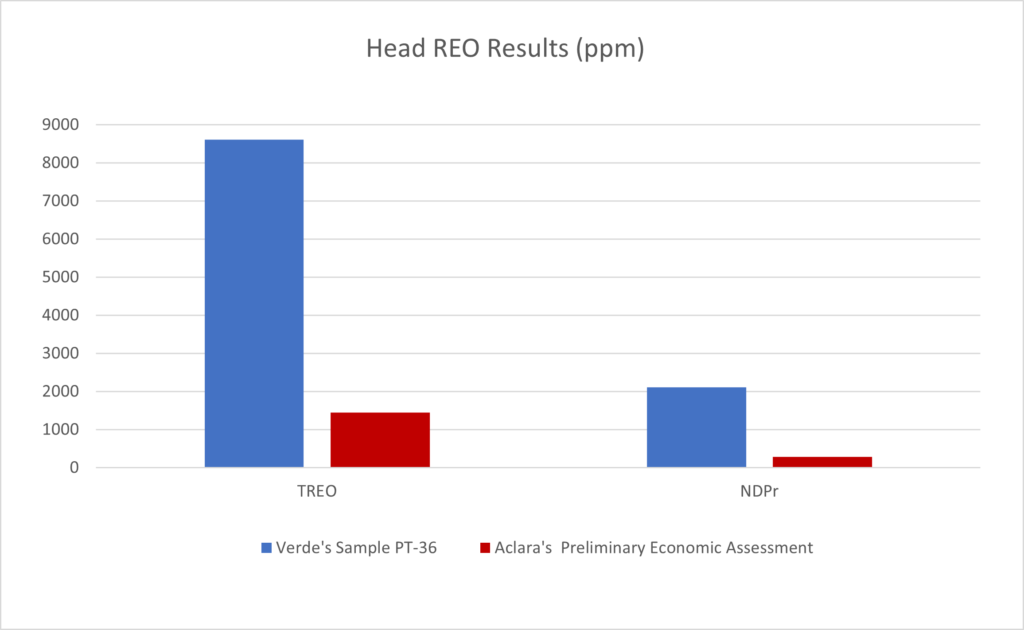
Figure 2 – Minas Americas vs. Carina – Disordable Results
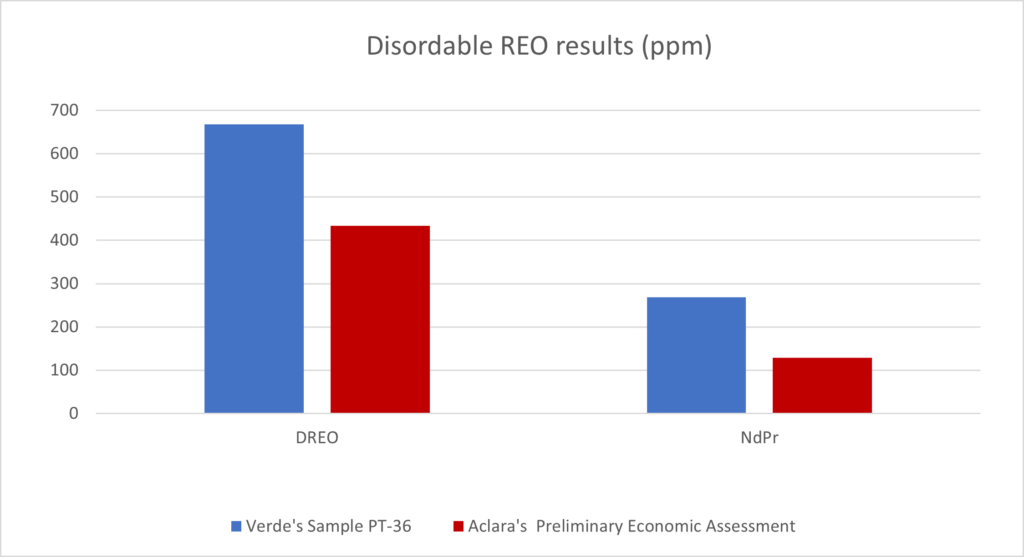
Figure 3 – Minas Americas vs. Carina – NdPr in DREO Results
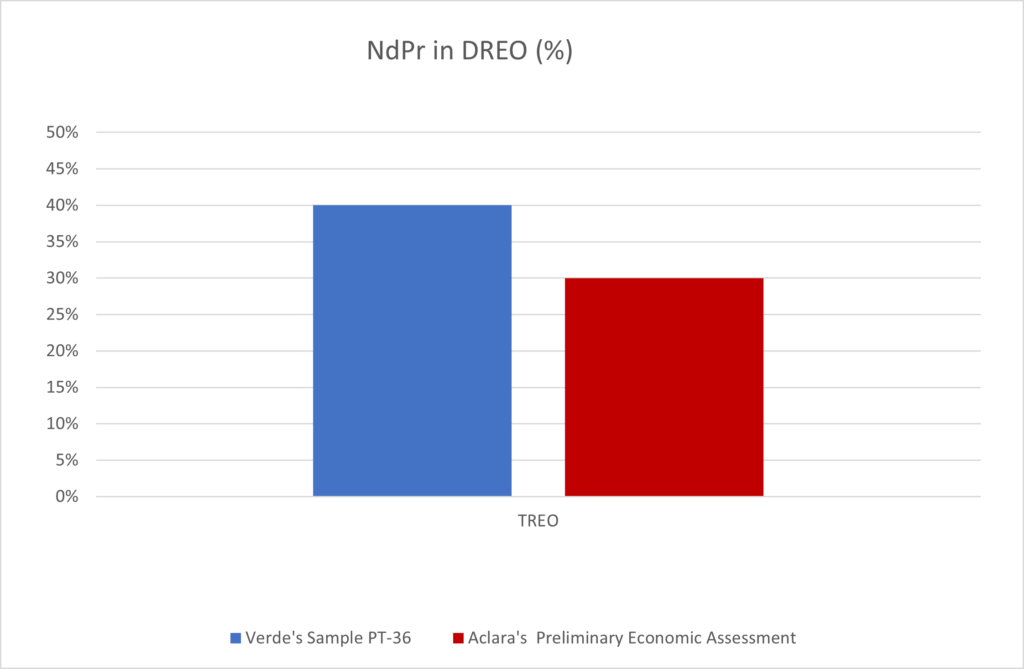
Aclara’s head grades above are averaged over a large Indicated Resource; the Project results are early‑stage trench intervals. Nonetheless, on a leachate concentration basis (what goes into the plant), the Project’s best PLS magnet grades are competitive to superior while maintaining exceptionally low impurities.
* Aclara Resources Mineração Ltda.; GE21 Consultoria Mineral. Carina Rare Earth Element Project — Preliminary Economic Assessment Update. GE21 Project No. 240205. May 3, 2024. 322 p.
Metallurgy: Why the First SGS Screen is Conservative and Why Stage Two Testing Lifts Recoveries
All leach results reported today come from an SGS Geosol screening test designed to answer a simple question: Are the rare earths ion adsorbed and therefore readily exchangeable? To keep that diagnostic clean and comparable, the procedure intentionally uses a single, short leach (0.5 M ammonium sulfate, ~30 minutes) on the as received, screened material and then reads the dissolved rare earths in the solution. It does not attempt to maximize extraction. In our program, SGS applied method ICM694 (0.5 M (NH₄)₂SO₄; 30 minute contact) after routine sample prep; results are reported as oxides (REO). This is the right first step for ionic clay projects because it isolates the exchangeable fraction and demonstrates low impurity solubilization. For example, in sample OB56 the leachate contained ~383 mg/kg TREO including ~127 mg/kg Nd₂O₃ and ~29 mg/kg Pr₆O₁₁, with Th and U near detection limits—evidence of selective ion exchange with minimal contaminant carryover under very mild conditions.
Because this diagnostic is purposefully mild, it under reports what a plant level flowsheet can achieve. Several built in limitations suppress extraction: (i) a single short contact rather than multiple counter current stages; (ii) fixed ionic strength (0.5 M) and no pH ramping to keep clays dispersed and prevent readsorption; (iii) no pre conditioning/attrition to expose exchange sites; (iv) no residence time optimization or temperature control; and (v) no recycle/bleed management of the leach liquor. In practice, proper metallurgical testing for ionic clays moves to staged agitated and/or percolation leaching with controlled pH (typically mildly acidic), optimized solid–liquid ratios, higher or stepped salt strengths, dispersants to limit flocculation, and counter current washing. These steps systematically (1) access additional exchange sites, (2) prevent rare earth readsorption as the solution becomes depleted, and (3) concentrate REE in solution while continuing to show low co leaching of Al/Fe/Si. Our initial dataset already points to that selectivity: major gangue oxides are very low in solution, and radioactive/penalty elements are at or near zero—favorable foundations for scaled processing.
What to expect next: Stage two metallurgical work for Verde’s Preliminary Economic Assessment, expected to be released in Q2 2026, will therefore implement multi-stage, counter current leaching and washing sequences (agitated and column), pH/ionic strength profiling, residence time optimization, and dispersion control. The objective is to translate today’s conservative, single pass screen into materially higher extractions of NdPr, Dy and Tb in line with commercial ionic clay practice—while preserving the clean impurity profile indicated by the SGS screen. As those flowsheet elements are introduced, recoveries typically step up materially from the initial screen because we are no longer constrained by a one and done 30-minute contact at fixed strength. We will report those stage two results as they are completed.
QA/QC and Qualified Person
Sample preparation and analytical methods. Samples were analyzed by SGS Geosol Geosol Laboratórios Ltda. (Vespasiano, Brazil), an ISO/IEC 17025:2017-accredited and independent commercial laboratory. For total element concentrations, samples underwent lithium metaborate fusion with ICP-OES/ICP-MS finish (SGS method codes IMS95A/ICP95A). Selective leachates were prepared using a 0.5 M ammonium sulfate leach for 30 minutes (SGS method ICM694) with ICP-MS finish.
QA/QC. The Company inserted certified reference materials, blanks and field/pulp duplicates at ~12% of the sample stream, and monitored laboratory internal controls. The QA/QC results were reviewed by the Qualified Person and were within acceptable limits for this stage of exploration.
Qualified Person. The scientific and technical information in this news release has been reviewed and approved by José Márcio Matta Machado Paixão, FAusIMM, who is a Qualified Person as defined by NI 43-101 and is independent of the Company within the meaning of NI 43-101. Mr. Paixão has verified the data disclosed herein by reviewing laboratory certificates, QA/QC performance (blanks/CRMs/duplicates) and analytical procedures.
About Verde AgriTech
Verde AgriTech is dedicated to advancing sustainable agriculture through the innovation of specialty multi nutrient potassium fertilizers. Our mission is to increase agricultural productivity, enhance soil health, and significantly contribute to environmental sustainability. Utilizing our unique position in Brazil, we harness proprietary technologies to develop solutions that not only meet the immediate needs of farmers but also address global challenges such as food security and climate change. Our commitment to carbon capture and the production of eco-friendly fertilizers underscores our vision for a future where agriculture contributes positively to the health of our planet. For more information on how we are leading the way towards sustainable agriculture and climate change mitigation in Brazil, visit our website: https://verde.ag/en/home.
Cautionary Language and Forward-Looking Statements
This news release contains “forward‑looking information” and “forward‑looking statements” (together, “FLI”) within the meaning of applicable Canadian securities laws. FLI relates to future events or performance and reflects management’s current expectations and assumptions. FLI in this news release includes, but is not limited to, statements regarding: the interpretation and significance of exploration and leach test results; the potential for ionic‑adsorption clay mineralization and for economic extraction of rare earth elements; the selectivity of magnet rare earths in solution and implications for processing; comparisons to other projects; anticipated metallurgical programs and flowsheet development (including staged, counter‑current leaching and washing); the expected timing, scope and outcomes of further testwork and studies (including a potential preliminary economic assessment (PEA)) currently targeted for release in Q2 2026; plans for project advancement; potential strategic initiatives and partnerships; and the timing and content of future updates.
Material assumptions
Material factors and assumptions used in developing the FLI include, without limitation: that trench and leach results are representative of broader mineralized horizons; continuity of ionic‑adsorption behaviour; scalability of laboratory procedures to pilot or commercial settings; availability and performance of reagents and process consumables; the ability to further optimize leaching, washing and impurity control while maintaining selectivity; reasonable access to the Project area, services and infrastructure; the availability of financing on acceptable terms; stable political, regulatory, community and permitting environments; sustained demand and pricing for rare earth products (including Nd, Pr, Dy and Tb); and exchange rates and operating cost inputs consistent with historical ranges.
Material risk factors
FLI is subject to known and unknown risks, uncertainties and other factors that may cause actual results to differ materially. These include, without limitation: risks inherent to early‑stage exploration projects; that subsequent work may not confirm initial exploration or leach results; metallurgical risks in scaling from bench to pilot/industrial operations; sampling, analytical and interpretive uncertainties; comparisons to peer projects that may not be valid due to differences in geology, scale, test conditions, project stage or assumptions; commodity price and exchange‑rate volatility; access to capital; cost inflation and supply‑chain disruptions; availability of water, power, reagents and skilled labour; environmental, permitting, title, tenure and community risks (including Indigenous engagement); changes in laws, regulations, policies or enforcement; political and country risk; counterparty and offtake risks; and the other risks set out in the Company’s most recent Annual Information Form, MD&A and other continuous disclosure documents available under the Company’s profile at www.sedarplus.ca .
Caution to readers
Although the Company believes the assumptions and expectations reflected in the FLI are reasonable as of the date hereof, no assurance can be given that they will prove correct. Readers are cautioned not to place undue reliance on FLI. The FLI herein is made as of the date of this news release, and the Company does not undertake any obligation to update or revise such FLI except as required by applicable securities laws. The Company’s policy is to update previously disclosed material FLI as required by NI 51‑102 through subsequently filed MD&A or news releases.
Technical and NI 43‑101 Cautionary Statements
The exploration and test results reported are preliminary in nature and do not constitute mineral resources or mineral reserves as defined by National Instrument 43‑101 – Standards of Disclosure for Mineral Projects (NI 43‑101). There is no certainty that further exploration will result in the delineation of mineral resources or reserves, that any economic analysis will be completed, or that any development decision will be made.
Any discussion of a potential PEA relates to a contemplated future study. No PEA results are being disclosed in this news release. If a PEA is completed and disclosed in the future, the Company will include all cautionary language required by NI 43‑101 for any economic analysis that includes or is based on inferred mineral resources.
Reported impurity and radionuclide observations (e.g., thorium/uranium below detection in certain intervals) are limited to the methods, detection limits and sample intervals tested and may not be representative of the property as a whole.
Comparisons to other issuers’ properties and results (including Aclara’s Carina Project) are provided for context only, are based on public disclosures and/or cited technical sources, and are not necessarily indicative of results that may be achieved at the Company’s Project. Differences in geology, testwork, scale, stage of development and assumptions can materially affect outcomes.
The scientific and technical information in this news release has been reviewed and approved by a Qualified Person under NI 43‑101 as disclosed herein. Terms such as TREO, MREO and DREO are used as defined in the news release for clarity and are not CIM‑defined categories.
For additional information please contact:
Cristiano Veloso, Chief Executive Officer and Founder
Tel: +55 (31) 3245 0205; Email: investor@verde.ag
www.verde.ag | www.investor.verde.ag
